Share
Share

Forest Bathing Guide for Retreat Facilitators: Science-Backed Nature Meditation Benefits
Jump to section
- What forest bathing means
- Five-senses practice
- Mindful walking basics
- Structuring sessions
- Scientific benefits
- Common mistakes
- Digital detox importance
- Integration practices
Want to host your retreat?
Nature-Based Meditation: Forest Bathing and Mindful Walking
Most retreat facilitators miss the simplest, most powerful practice available to them. It requires no special equipment, costs nothing, and produces measurable results in fifteen minutes.
Forest bathing—the Japanese practice of shinrin-yoku—isn’t hiking or exercise. It’s intentional immersion in forest atmosphere, and the research is remarkable. Just 15 minutes of forest walking decreased cortisol levels in 69% of participants, dropping from 9.70 to 8.37 nmol/L.
When you combine this with mindful walking meditation, something extraordinary happens. Your participants don’t just feel better—their bodies measurably change at the cellular level.
What you’ll find in this guide
- How forest bathing increases natural killer cell activity by up to 50%—with immune-boosting effects lasting 30 days after a single session
- The science behind mindful walking meditation that shows measurable improvements in blood pressure, stress hormones, and cognitive function
- Why 20 consecutive days of forest walking produced a 24.6% reduction in systolic and 29.5% reduction in diastolic blood pressure
- Practical techniques for engaging all five senses in nature to maximize therapeutic benefits
- How to create an effective nature meditation practice whether you live near forests or in an urban environment
What forest bathing actually means (and why it works)
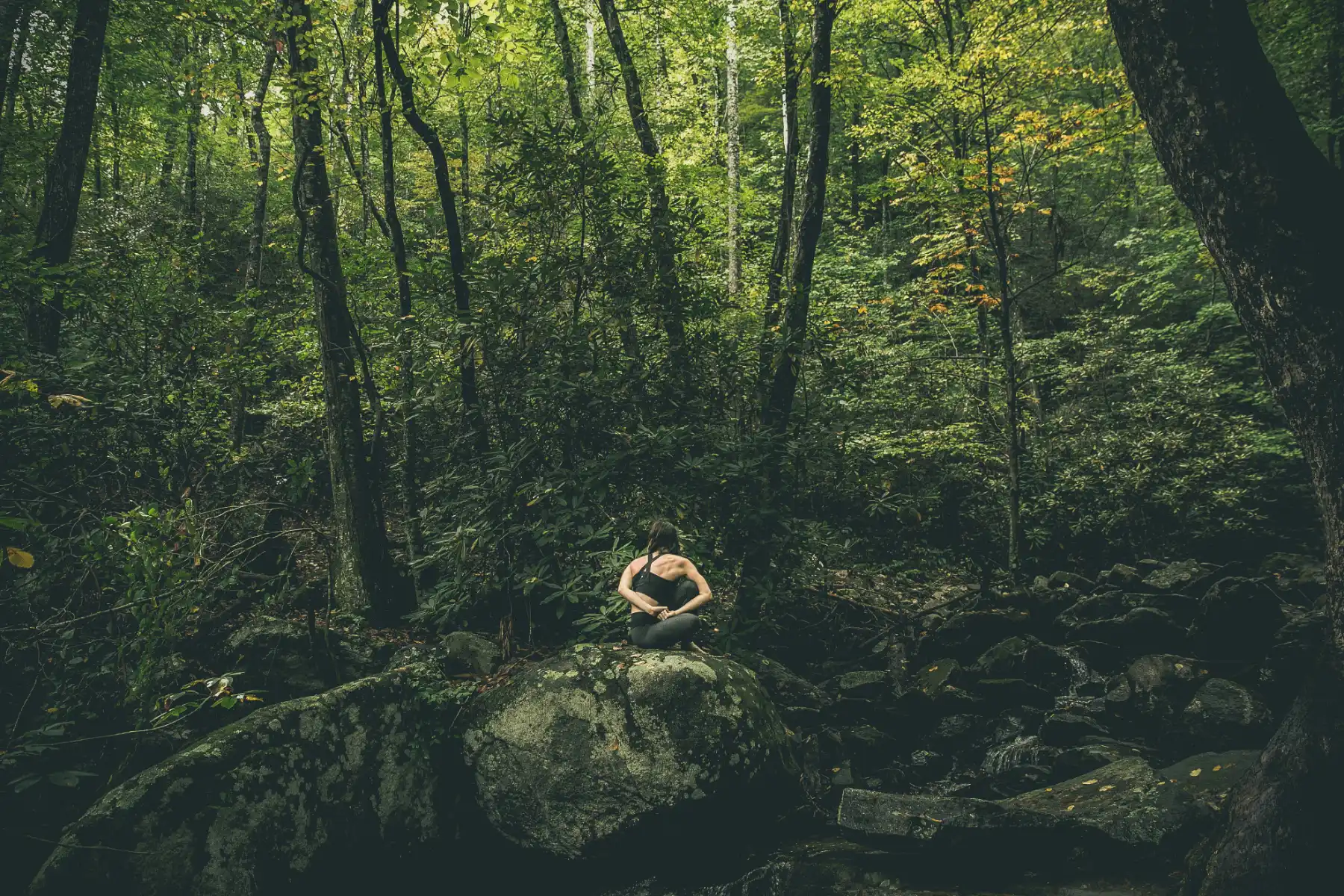
Forest bathing isn’t about reaching a destination or burning calories. According to research from Nature Scientific Reports, it means immersing yourself in forest environments while engaging all five senses.
The Japanese developed this practice in the 1980s as preventive medicine. What they discovered changed how we understand nature’s therapeutic power.
Trees release phytoncides—airborne chemicals that protect them from insects and decay. When humans breathe these compounds, our bodies respond by increasing natural killer cells by up to 50% for a full week after a single forest session.
How you can introduce it:
- Frame forest bathing as “medicine” rather than recreation—this shifts participant mindset immediately
- Explain that the practice requires no special skills, just willingness to slow down
- Set realistic expectations: even 15-20 minutes produces measurable benefits
- Emphasize that this isn’t about distance covered or destinations reached
The American Psychiatric Association published a meta-analysis of 971 studies confirming significantly lower cortisol levels. Some studies report cortisol reductions up to 50%.
💡 Quick Tip: The best forest bathing happens at about 200-300 meters per hour—roughly half the speed of your slowest participant’s normal walking pace.
The five-senses practice that grounds participants immediately
Most facilitators complicate forest bathing with elaborate instructions. Your participants don’t need complexity—they need permission to notice what’s already present.
The five-senses framework provides structure without rigidity. You guide attention through each sensory channel, allowing participants to anchor in direct experience rather than mental chatter.
Start with sound because it’s the easiest entry point. The jungle provides a natural soundscape—bird calls, rustling leaves, distant waves. Participants can notice these without trying.
How you can do it:
- Sound (3-4 minutes): “Close your eyes. Notice the nearest sound. The farthest sound. What changes when you stop trying to identify what makes each sound?”
- Touch (3-4 minutes): “Feel the air temperature on your skin. The ground beneath your feet. Place your hand on tree bark—what texture do you notice?”
- Sight (3-4 minutes): “Open your eyes softly. What do you see without naming it? Notice light and shadow, movement and stillness.”
- Smell (2-3 minutes): “Breathe deeply. What scents are present? Earth, flowers, salt air? Just notice without judgment.”
- Taste (1-2 minutes): “If you have a leaf of mint or citrus, place it on your tongue. Or simply notice the taste of the air itself.”
The entire sequence takes 15-20 minutes. That’s all you need to shift nervous systems from sympathetic (stress) to parasympathetic (rest) activation.
How mindful walking differs from ordinary movement
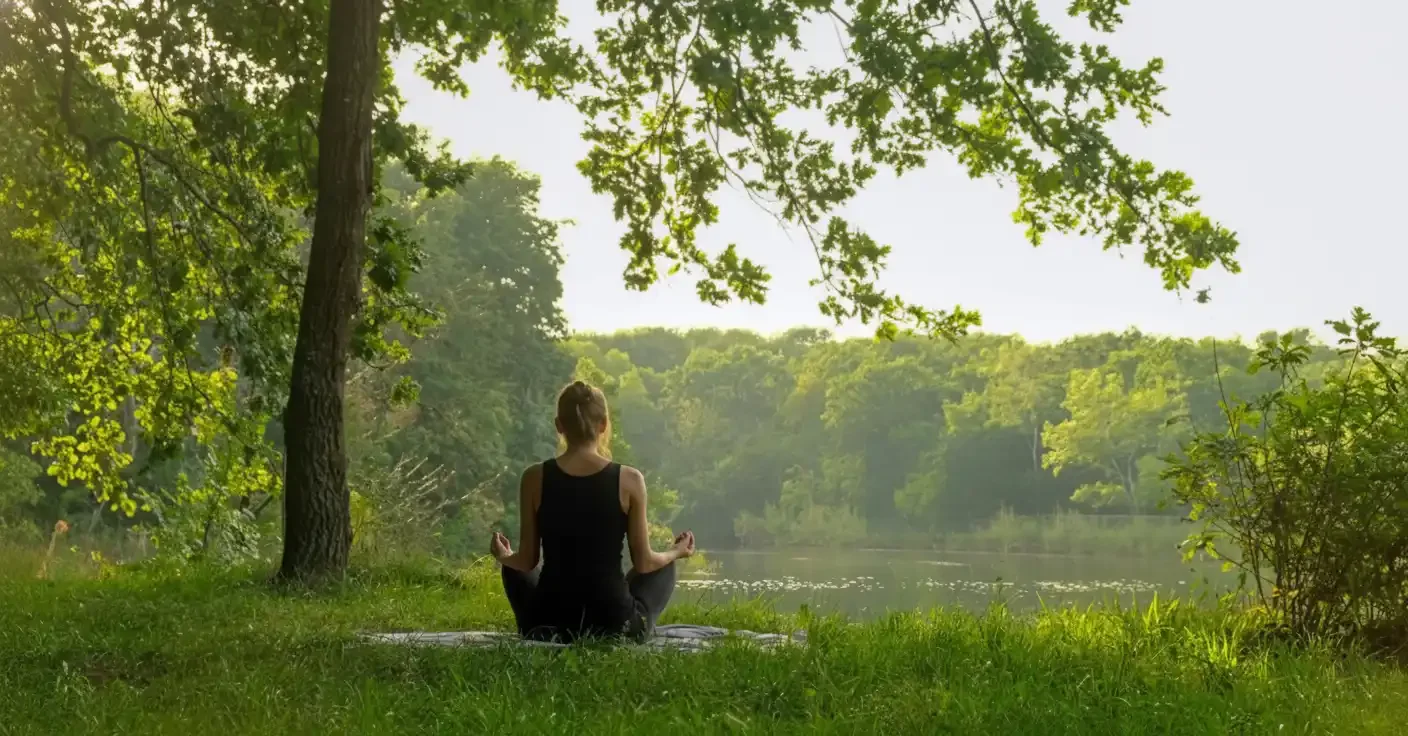
Mindful walking meditation combines gentle movement with present-moment awareness. Unlike destination-focused walking where you’re trying to get somewhere, this practice keeps attention on the process itself.
The Cardiometabolic Health organization found that walking meditation reduces stress, anxiety, and depression while improving sleep quality and cardiovascular health.
Research from UC Davis Health shows that just 20 minutes of nature exposure significantly lowers stress hormone levels. When you combine that with meditative movement, the effects compound.
How you can do it:
- Pace: Move slower than normal—roughly one-third to one-half your regular speed
- Attention: Focus on physical sensations in your feet and legs with each step
- Awareness: Notice when your mind wanders and gently return to bodily sensations
- Breath coordination: Try matching breath to steps—inhale for 3 steps, exhale for 3 steps
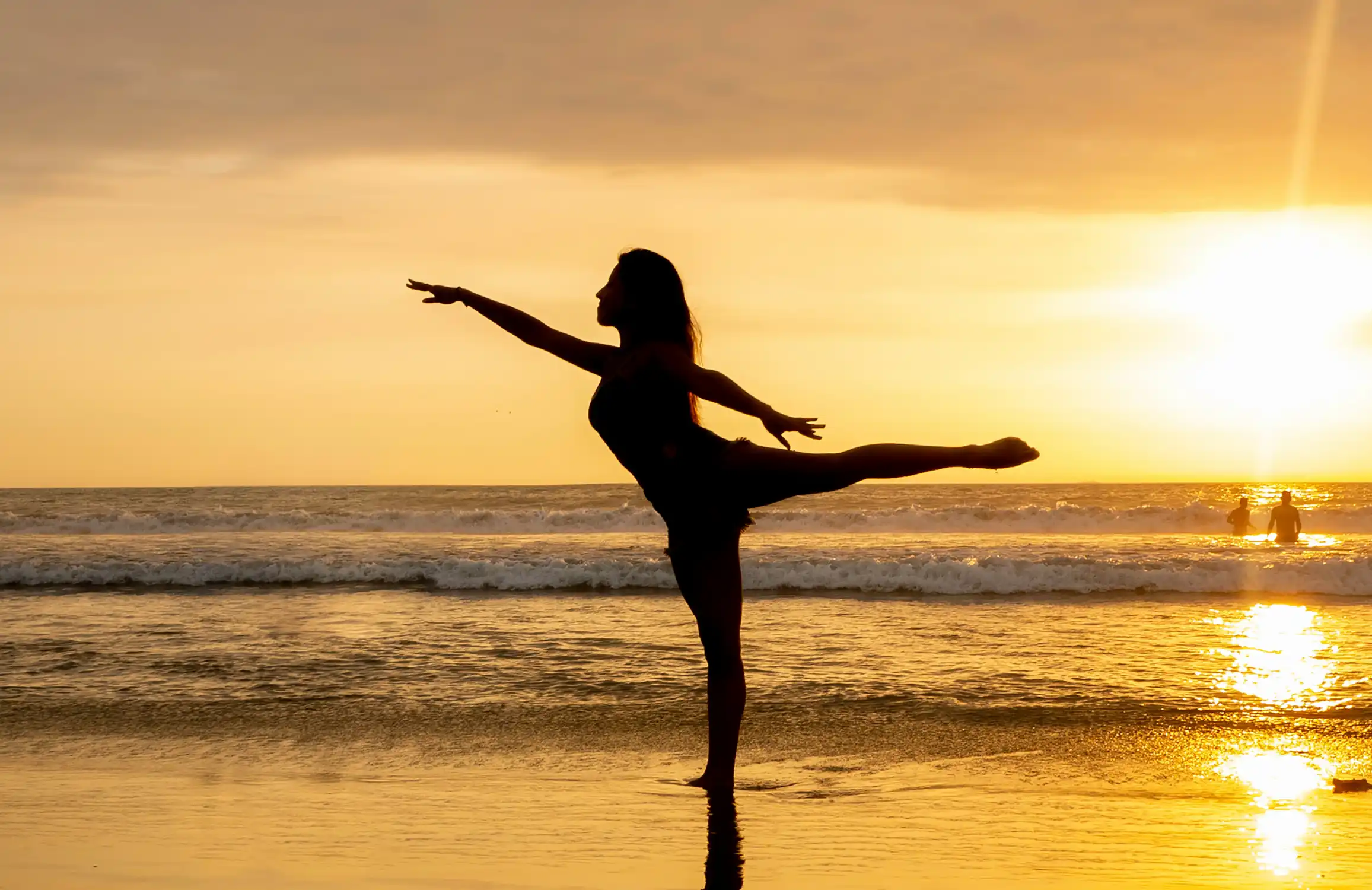
At Brisa Bahía, facilitators often lead mindful walking sessions along the beach at sunrise. The combination of soft sand underfoot, ocean sounds, and early morning light creates optimal conditions for nervous system regulation.
📖 Real Example:
A yoga teacher hosting at Brisa Bahía introduced 10-minute barefoot walking sessions before morning practice. Participants reported feeling more grounded and present than in previous retreats where yoga began immediately after breakfast. The barefoot contact with earth and sand created what she called “instant arrival.”
How to structure sessions for different group sizes
A forest bathing session for 6 participants looks completely different than one for 24. The principles stay the same, but the logistics shift dramatically.
Small groups (6-12 people) can move together with frequent stops. You lead from the front, pause regularly, and offer invitations rather than instructions.
Larger groups (13-24 people) need more space and autonomy. Consider breaking into smaller pods with designated “quiet zones” where participants can wander independently within sight of the group.
How you can do it:
For intimate groups (6-12):
- Move as one unit with you setting the pace
- Stop every 50-75 meters for a sensory invitation
- Create moments of complete silence (2-3 minutes)
- Allow participants to naturally space themselves along the trail
For larger groups (13-24):
- Establish a “base camp” where the session begins and ends
- Define clear physical boundaries for independent wandering
- Set a specific timeframe (20-30 minutes) for solo exploration
- Use a gentle bell or singing bowl to signal gathering times
- Pair participants for brief sharing afterward (3-4 minutes each)
Join Our Retreat Community
Weekly insights on retreat planning, nature-based practices, and life on Colombia’s Caribbean coast. Join 1,000+ facilitators in our community.
Your data is safe with us. Unsubscribe anytime.
The scientific benefits that convince skeptical participants
When participants question whether “just walking in nature” can create real change, the research provides compelling answers.
According to studies published by the National Institutes of Health, forest bathing increases natural killer cell activity by up to 50%. These immune cells are your body’s first defense against cancer and viruses.
Even more remarkable? These effects last up to 30 days after a single forest bathing session.
The cardiovascular benefits compound over time. Twenty consecutive days of forest walking produced a 24.6% reduction in systolic and 29.5% reduction in diastolic blood pressure in research participants.
The mechanism works like this:
- Trees release phytoncides—aromatic compounds for self-protection
- When humans breathe these compounds, they stimulate immune protein production
- Natural killer cells increase production of perforin, granulysin, and granzymes
- The immune system maintains this elevated state for weeks
Mental health benefits appear even faster. Research on meditation and heart health shows that nature-based practices reduce anxiety as effectively as many medications, with none of the side effects.
“The moment I stopped trying to ‘do’ forest bathing correctly and just noticed what walking felt like, everything shifted. Suddenly I wasn’t performing meditation—I was experiencing it.”
The three mistakes that undermine nature-based meditation
Even experienced facilitators make these errors. Each one subtly shifts the practice from transformative to performative.
Mistake #1: Talking too much. Your participants don’t need constant guidance. They need space to discover their own experience. According to forest bathing protocols, facilitators should speak for less than 20% of the session.
Mistake #2: Making it goal-oriented. The moment you suggest participants should “achieve” relaxation or “find” insight, you’ve created striving. Forest bathing works precisely because there’s nothing to accomplish.
Mistake #3: Skipping the integration. Without time to process and share, the experience evaporates. Participants need 5-10 minutes to name what they noticed before moving to the next activity.
How you can do it:
- Limit verbal guidance to brief invitations every 3-5 minutes, then stay silent
- Replace achievement language (“try to notice”) with invitation language (“you might notice”)
- Build in structured sharing time—small groups of 2-3 work better than full group sharing
- Ask reflective questions: “What surprised you?” rather than “Did you relax?”
💡 Quick Tip: When you notice yourself about to speak during a forest bathing session, wait one full minute. Most of what you want to say is unnecessary—the forest teaches better than words.
Why phones disrupt forest bathing (and what to do about it)
According to REI’s research analysis, phones disrupt forest bathing benefits by up to 40%. This isn’t just about distraction—it’s physiological.
Your phone prevents the parasympathetic nervous system activation that forest bathing creates. The electromagnetic frequencies, notification anticipation, and constant partial attention block the relaxation response.
The solution is simple but challenging: complete phone separation during nature sessions.
How you can do it:
- Establish a “phone-free zone” at the trailhead where devices stay in bags
- If participants must bring phones for emergency, require airplane mode
- No photos for the first 30 minutes (if documentation is essential, allow it at the end)
- Explain the research—participants comply when they understand why
At our secluded sanctuary, natural digital detox happens automatically. No cell signal means no connectivity stress. Facilitators report that participants drop into deeper states faster when technology isn’t an option.
Integration practices that help participants take it home
Your participants won’t have access to pristine jungle trails in their daily lives. But they can practice forest bathing in city parks, suburban greenways, even their own backyards.
Get Your Free Nature-Based Practices Guide
Download our complete guide to integrating forest bathing, mindful walking, and other nature-based practices into your retreat programming. Includes session templates, timing guides, and integration exercises.
Integration practices that help participants take it home
Your participants won’t have access to pristine jungle trails in their daily lives. But they can practice forest bathing in city parks, suburban greenways, even their own backyards.
The key is helping them understand that forest bathing is about quality of attention, not quality of wilderness. According to research on nature exposure, 120 minutes per week produces measurable health benefits regardless of setting.
Teach them to identify “nature minutes” in their existing routines. The walk from parking lot to office. The bench outside during lunch break. The tree visible from their window.
How you can do it:
- Micro-practices: Teach 3-minute versions—one sense, deep attention, done
- Morning ritual: Suggest 5 minutes of barefoot standing on grass or earth each morning
- Commute transformation: If they walk or bike anywhere, apply mindful attention for just the first and last minute
- Technology boundaries: Help them commit to phone-free nature time, even if brief
- Seasonal awareness: Notice how the same location changes through seasons
Provide participants with a simple take-home protocol. One page, five practices, each taking less than 10 minutes makes the practice sustainable.
📖 Real Example:
One facilitator created a “21-day forest bathing challenge” for post-retreat support. Participants committed to just 5 minutes daily in any natural setting, posting photos in a private group. Adherence stayed above 70% for the full three weeks because the time commitment felt doable.
Where to go from here
You now have everything you need to lead transformative forest bathing sessions. The science backs the practice. The structure is simple. Your role is to create space and get out of the way.
Start with a single 20-minute session during your next retreat. Keep it simple—five senses, slow pace, minimal talking. Notice what shifts in your participants.
The forest doesn’t need your expertise. It needs your willingness to let participants encounter something older and wiser than any teaching you could offer. Trust the trees to do their work.
Host Your Retreat at Brisa Bahía
Secluded beachfront sanctuary on Colombia’s Caribbean coast near Capurganá. Exclusive-use property for 12-24 guests. Pristine jungle with maximum phytoncide exposure, guided hikes to waterfalls and sacred rivers, complete digital detox environment—we handle logistics while you focus on transformation.
Sources & Further Reading
Nature Scientific Reports – Forest Bathing Enhances Human Natural Killer Cells |
American Psychiatric Association – Forest Bathing Benefits |
Three-Step Guide to Forest Bathing |
NIH – Effects of Forest Bathing on Immune Function |
The Role of Meditation in Heart Health |
Meditation Benefits in Heart Patients |
UC Davis Health – Nature Improves Health |
REI – Phone Use Disrupts Forest Bathing |
Ecology and Society – Nature Exposure for Health